

Kubernetes Community Days Suisse Romande

We had the opportunity to attend Kubernetes Community Days (KCD) Suisse Romande, held at CERN in Geneva, on December 4th and 5th.
These two days were full of discussions, workshops (we had the opportunity to participate to the Exoscale capture the flag workshop), and technical talks focused on Kubernetes and the cloud-native ecosystem.
Rather than diving deeply into low-level technical details, we would like to highlight three key topics that particularly caught our attention during the event; each reflecting important trends in how Kubernetes is evolving broader and wider on the market.
KServe: Hosting LLMs and ML Models on Kubernetes
One of the most hot topics was KServe, an open-source project that belongs to the Knative ecosystem and enables deployment, scaling, and serving of machine learning models directly on Kubernetes clusters.
Through a single Custom Resource Definition (CRD), InferenceService, KServe exposes models via HTTP or gRPC endpoints while dynamicly handling autoscaling, resource allocation, networking, rolling updates, and revision management.
It supports multiple popular ML runtimes as well as fully custom containerized models. Thanks to Knative, KServe can scale workloads down to zero pods, significantly reducing infrastructure costs when models are idle and not actively used.
Architecture:
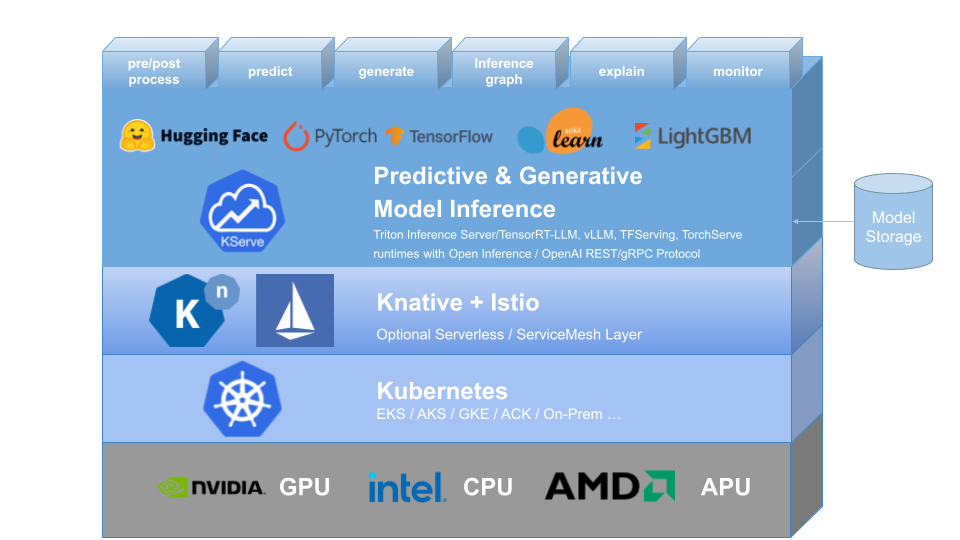
More info here : https://kserve.github.io/website/
KubeVirt: Running Virtual Machines on Kubernetes
Another strong theme was KubeVirt, a Kubernetes extension that allows virtual machines to run natively alongside containers within the same cluster.
By introducing virtualization primitives through CRDs such as VirtualMachine and VirtualMachineInstance, KubeVirt makes it possible to orchestrate VMs using standard Kubernetes tools and workflows.
Under the hood, it relies on KVM/QEMU, while integrating with Kubernetes concepts like RBAC, CNI networking, and PersistentVolumeClaims.
This approach helps organizations to unify containerized and legacy workloads under a single control plane!
Features such as live VM migration, GitOps-driven lifecycle management, and gradual modernization of existing applications make KubeVirt a powerful path between traditional virtualization and cloud-native platforms.
Example:
apiVersion: kubevirt.io/v1
kind: VirtualMachine
metadata:
  name: test-vm
spec:
  running: true                 # Vm auto starts
  template:
    spec:
      domain:
        devices:
          disks:
            - name: containerdisk
              disk: {}
        resources:
          requests:
            memory: 256Mi
      volumes:
        - name: containerdisk
          containerDisk:
            image: quay.io/kubevirt/cirros-container-disk-demo
Cluster API: Kubernetes Managing Kubernetes
The third topic that stood out was Cluster API (CAPI), an open-source framework designed to manage the full lifecycle of Kubernetes clusters using Kubernetes itself.
So, clearly, the cluster becomes a K8s object itself !
Cluster API introduces a set of declarative CRDs ( Cluster, Machine, and MachineDeployment, etc) that allow infrastructure provisioning, node bootstrap, upgrades and multi-cloud management to be expressed as code.
One of Cluster API’s major aspects is its provider model: the same API can manage clusters across platforms like vSphere, Azure, AWS, Nutanix, and others. This brings a uniform, automated, and repeatable approach to Kubernetes operations, regardless of the underlying infrastructure! A real game changer !
Conclusion
We would like to thank all the participants and organizers for these two instructive days! It was a great opportunity of exchanges, new product discovery and cool talks with a lot of different people, expanding capabilities and community aspects !
For anyone curious about Kubernetes, cloud-native technologies, or the future of infrastructure and AI platforms, we can only encourage you to join future editions of this event. The community, the knowledge sharing, and the discussions make it well worth the time.
For those who would like to see all the talks, everything is available here:
https://www.youtube.com/playlist?list=PLg2OjtyfIbOGVN6AIa-BVgL9i0SpR_tFD


